Aidan Givens
East of the MountainsAidan Givens, twenty months older than Ben Givens, is an amiable, steady presence in the family’s orchard life and Ben’s earliest adventures beyond it. Their bond is built through repeated acts of work and exploration: clearing irrigation ditches, riding into the desert, swimming in the river, and climbing and skiing in the mountains. When Aidan is drafted into the United States Army, his private admission that he would rather stay home gives their final ride together the weight of a farewell.
Identity and Background
Aidan is described as stocky, sturdy, and even-tempered, with brown skin and blue eyes. He works with a pine sliver between his teeth and sweat darkening his shirt; his hat brim usually shades his eyes. When someone addresses him, he tips the brim up and listens with animation around the eyes before answering. The small, characteristic gesture matches the larger impression of an agreeable, attentive man.
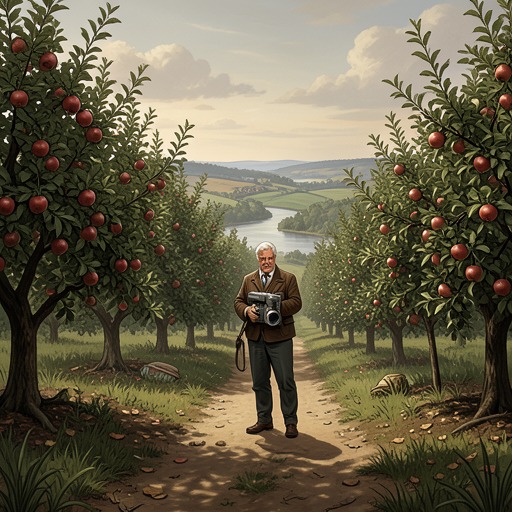
He grows up with Ben on the family’s Columbia River orchard, where the surrounding landscape joins home and work to the natural world. The orchard occupies the river’s east bank, sheltered by Lombardy poplars and laid out in fruit-tree rows, irrigation ditches, and branch props. Beyond the cultivated ground begins a desert of buttes, coulees, and unnamed canyons. These are not separate worlds for the brothers: the same childhood that binds them to seasonal farm labor also gives them a route into the open country.
Work and the Orchard Seasons
Aidan’s youth is shaped by the orchard’s continuous cycle of tasks. He and Ben help their father make apple boxes, tend the kitchen garden, split firewood, and milk cows twice daily. In spring, they help set out pollinating hives; when weeds clog the sluice gates, they stand in the ditches and clear them by hand. They plant windbreaks and young trees, pull out finished trees, and disc between the rows in early summer to keep mice from the orchards.
The work continues as the fruit develops. In July the brothers fit spreader sticks to yearling trees and strap back their branches; in midsummer they thin fruit and carefully prop and secure limbs against the weight of apples. Picking comes in August, followed by pruning and the burning of water sprouts in fall and winter. The details place Aidan within a household whose livelihood depends on skilled, repetitive labor, not merely within an idyllic rural setting.
The harvest is also work shared with people who come from elsewhere. When the cherries ripen early, Aidan is no longer present in the described picking scene: the crew includes Ben, their father, migrant workers, and Rachel Lake, who has come from Waterville, Maine, to stay for the harvest. The scene nevertheless clarifies the scale and demands of the orchard life Aidan has shared with Ben: buckets and ladders fill the rows, fruit must be gathered with its stems intact, and the season stretches ahead through miles of trees and weeks of picking.
Shared Country and Mountain Adventures
Away from the rows, Aidan and Ben take their dogs into the desert to hunt quail, chukars, and sage grouse, sometimes getting a shot at a jackrabbit. When they can, they ride horses with shotguns across their backs and canteens striking against the saddles. On overnight trips they roast the birds they have shot, putting sage sprigs inside them before cooking the meat over a twig fire. Then the brothers lie beneath the sky and talk. Their shared outings combine practical familiarity with the land and a quieter companionship that has room for conversation and looking upward.
The river offers another, less arduous ritual. At dusk, Aidan likes to swim in an eddy just upstream from the ranch house. He and Ben strip on the bank, leave their clothes on the warm shore rocks, and splash into the water. They ride the current and swim against it while the orchard glows in the evening light. The scene makes their closeness ordinary and physical: they share not only the family’s work, but the same water, landscape, and unhurried hours.
In late fall, the family takes the train to Stevens Pass and walks open ridges in different kinds of weather. Aidan and Ben look down on forests whose density contrasts with the sage country to the east, and imagine hiking west into places no one has seen. Their talk turns them, briefly, into explorers rather than orchardists. In Leavenworth they buy wooden skis with bent-metal toepieces and leather straps. Their mother teaches them to snowplow, make a telemark turn, and stop in a christy; the brothers later ski on winter trips and fall repeatedly on the amateur jump trestle near Ski Hill Road. They also ski along Peshastin Creek and the Chum-stick River, earning each downhill run by climbing uphill with their skis on their shoulders.
On Mission Peak, that shared mountain life reaches a moment of almost spiritual intensity for Ben. With the December sky clear and the low sun pale among the peaks, Aidan points out a mountain goat less than twenty yards away. It vanishes behind an outcropping in a puff of snow. Ben, fastening his ski binding, feels poised at the world’s edge, with the wind, sky, snow, and winter sun seeming to disclose a truth beyond the reach of ordinary life. Aidan’s pointing gesture is brief, but he is present at one of Ben’s defining memories of the natural world.
Draft and the Last Ride
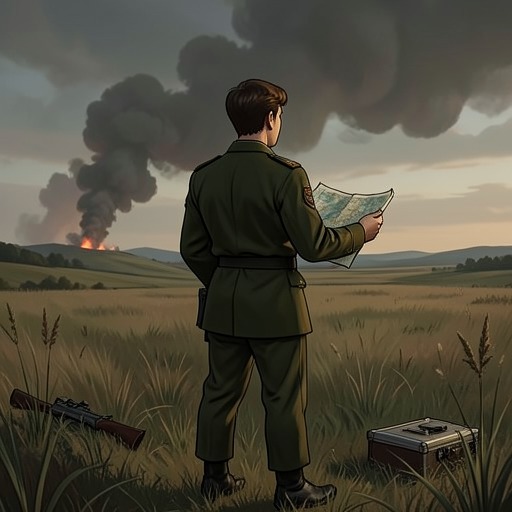
Fifteen months after the attack on Pearl Harbor, Aidan is drafted into the United States Army. Three days before leaving, he packs his bag and asks for one last ride in the Colockum country. At dawn, he and Ben saddle the horses and cross the river at Coleman’s Landing. They ride on empty stomachs until they stop at a spring for food from their saddlebags, then continue through Dry Springs Canyon and over the ridges. At dusk, Aidan shoots two blue grouse after they rise from low branches. The brothers camp near Spring Gulch among hoary willows, with the wind at their backs and the smoke streaming away from the fire.
A thunderstorm overtakes them at midnight. From the tent, they watch lightning flicker as rain falls so hard that the surrounding world disappears. They measure its easing by the changing sound on the canvas; when silence comes, they step out beneath the stars and a thin moon. In that pause after the storm, Aidan tells Ben, "I don't want to go." He says he can speak this truth only to Ben: he is not cut out for the Army and would rather be where they are. Ben answers, "I wish you were staying."
Aidan’s reluctance is bound to the life he knows rather than expressed as an abstract complaint. He kicks a loose stone and says, "I don't know nothing but apples," asking what the Army wants with him when he is only an apple farmer. The remark brings the brothers’ orchard labor into the farewell itself: the work that has formed their days is also the home Aidan fears leaving. They stand quietly in their blankets in the dark hills, with the decision to go still ahead of him.
Narrative Role and Significance
Aidan’s importance in the supplied narrative lies in the shared past through which Ben understands home. Orchard work gives their relationship a seasonal rhythm; hunting, river swims, climbing, and skiing extend it into places where the brothers can imagine a life beyond the farm. The last ride gathers these strands into one departure: horses, a hunted meal, a storm, and the brief return of stars frame Aidan’s plain admission that he would rather stay.
The account establishes that Aidan is drafted and leaves for military service, but does not provide his subsequent fate. His ending here is therefore an unresolved separation rather than a completed account of his life. In later present-day orchard country, Ben passes rows crowded with pickers, ladders, bins, and children resting in the grass. Aidan is not part of that scene, but the laboring landscape recalls the world the brothers once shared and makes the remembered orchard more than a backdrop: it is the home from which Aidan had to depart.